People from the Future is an immersive virtual reality simulation designed to investigate how direct, symbolic contact with future generations can shape the way people perceive climate change and their responsibility toward those who will live after us. The experience is grounded in social identity and social categorization approaches, exploring whether future generations can become psychologically included within a broader sense of “us” rather than being perceived as distant and abstract others.
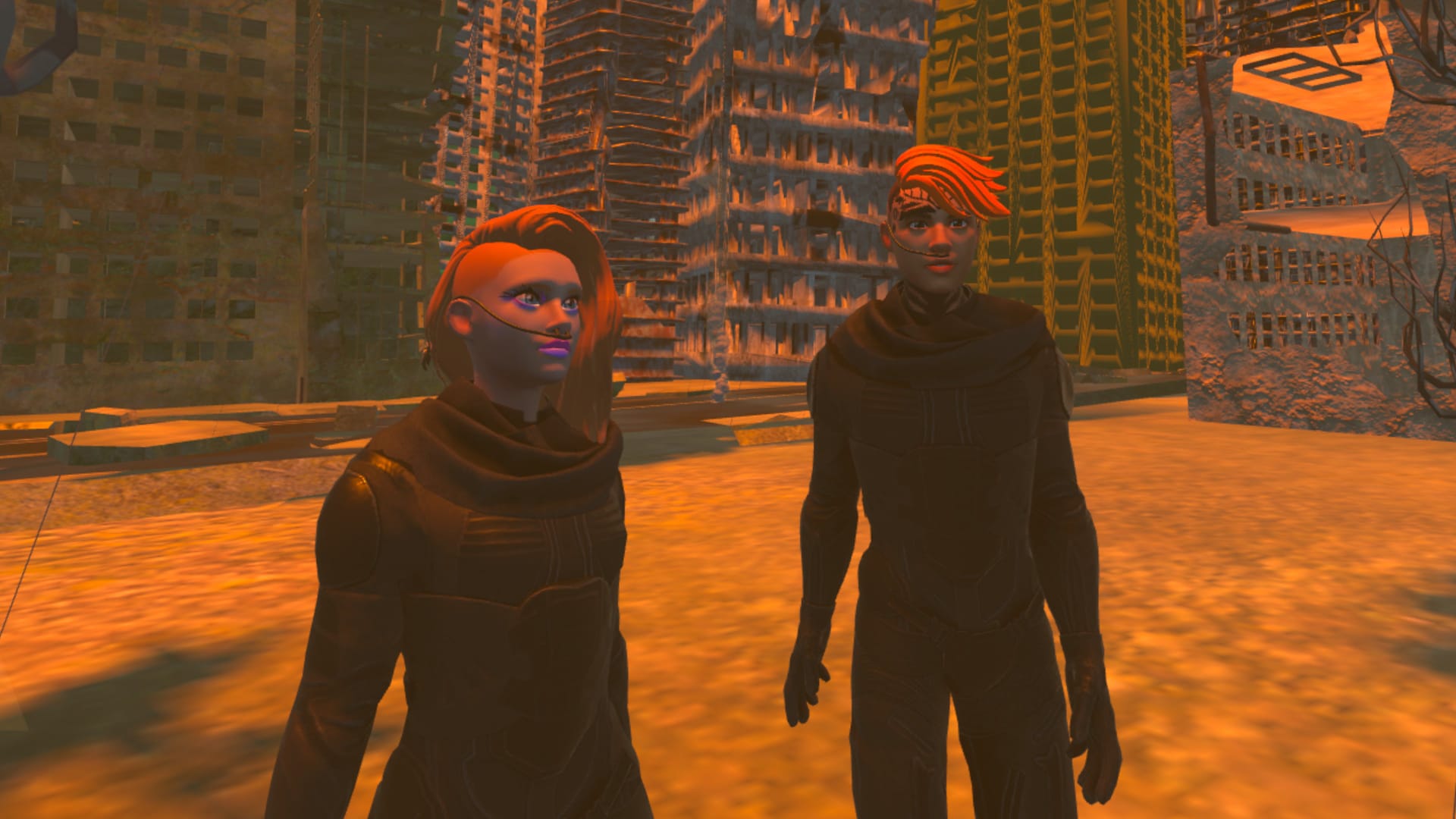
The simulation takes participants on a virtual journey from the present day to the year 2226. The experience is structured as a short narrative sequence: after an introductory scene, participants undergo a temporal transition that transports them more than two centuries into the future. They then find themselves in a city of 2226, where they encounter two inhabitants of the future who describe what has happened to human society over the intervening centuries.
The VR paradigm includes two experimental conditions. In the climate-change condition, participants enter a degraded future city where the consequences of global warming and ecological deterioration are clearly visible. The environment depicts a future characterized by impoverished landscapes, deteriorating living conditions, resource scarcity, and signs of ecological and social collapse. The two future inhabitants explain how climate change has affected both the environment and human life. In the neutral control condition, participants visit a future city of comparable immersive and perceptual complexity, but without references to climate change or environmental crisis. Here, the two inhabitants instead describe the evolution of human civilization and urban life.
Rather than simply presenting information about distant environmental consequences, the simulation is designed to make the future experientially and socially present. Meeting people who supposedly live in 2226 transforms future generations from an abstract category into concrete social actors with whom participants can interact. In this way, VR is used to investigate whether immersive contact with the future can increase emotional engagement, identification with future generations, perceived intergenerational continuity, and pro-environmental behavioural intentions.
The project therefore uses immersive technology not only to visualize a possible future, but also to explore a broader psychological question: can experiencing future generations as part of the same human community strengthen our sense of responsibility for the long-term consequences of present-day actions? The research specifically examines emotional responses, social identification with future generations, and pro-environmental intentions, while also assessing key VR-related processes such as presence and embodiment.
 '
'