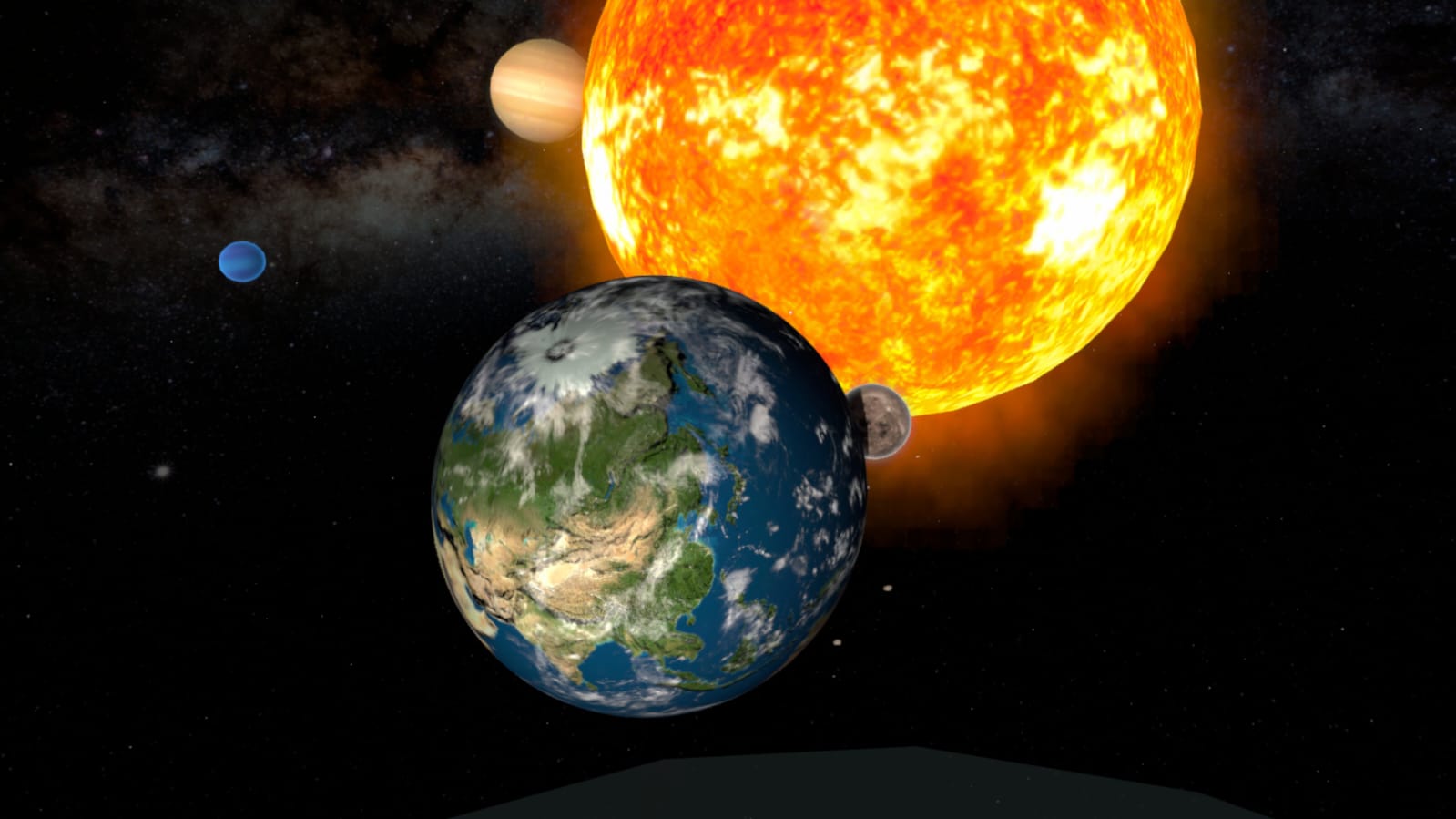
This virtual reality application was developed to experimentally elicit awe through immersive exposure to vast, extraordinary, and perceptually striking environments. The core experience places participants within a dynamic planetary scenario, where celestial bodies and large-scale spatial transformations are used to evoke a sense of perceptual vastness and to challenge ordinary frames of reference—two central features commonly associated with the experience of awe.
The application was built as a controlled research paradigm rather than as a purely narrative VR experience. Its structure allows researchers to expose participants to standardized immersive scenarios while maintaining control over the visual sequence, timing, environmental events, and progression of the experience.
In addition to the awe-inducing planetary environment, the application includes three control environments designed to support experimental comparisons across different immersive experiences. These include an amusement park, a city environment, and an additional control scenario. The control conditions make it possible to distinguish effects specifically associated with awe from those produced more generally by immersion, visual stimulation, novelty, or positive engagement.
The paradigm was originally developed as part of our research on the psychological effects of awe in virtual reality, including preliminary validation work examining whether the planetary environment is able to reliably elicit the target emotional experience. The broader research program investigates how VR-induced awe may influence social and psychological processes.
The application is currently under active testing and validation and is being used in ongoing experimental studies. For this reason, the present version should be considered a research prototype rather than a finalized standardized instrument. Its experimental structure and environments may continue to be refined as additional validation data become available.


 '
'